COPYRIGHT

All resources offered by this blogsite are shared by the authors themselves. Some of them were rewritten with permission and some were collected throughout the internet and exchanged between peers for personal study. Use of any resources offered for commercial purposes is prohibited. Otherwise you need to responsible for any consequences produced! Any profitable behavior of utilizing the resources downloaded from this site is condemned and disdained sternly.

Some of the resources, and data here were shared by the authors freely and we don't have all the capacity to know, if the components, materials inside the scenes were copyright protected. If you feel some resources have infringed your copyright, please contact us. We will delete them as quickly as possible. We won't bear any legal responsibility for the resources. Thanks.

Custom Search

Custom Search

Welcome to SketchUp, Vray and other Resources

Everyone is capable of learning. Learning is part of life. It is a social process of living and bringing everyone to share their inherited resources and discoveries. All of us can influence the life of others through sharing and caring. It is our belief that everyone should be a lifelong learner.

I am putting very important visualization resources and series: tutorials, tips, tricks, VRAY materials and settings, and mini-the-making (MTM) processes.

Yours,

Nomeradona

Showing posts with label sketchupartists. Show all posts

Saturday, 3 September 2011

Q and A: Ferry Sugianto


Bali, Indonesea is known for her craftsmanship, art, culture and tourism.  Wherever you look, you can see life; you can see culture  everywhere. Here is one place where you cannot separate art and life - "life itself is art". Here is where our next Sketchup Vray Featured artist is based: Ferry Sugianto, an architect, designer, visualiser and an active member of many SketchUp forums.  Ferry is not just an excellent visualizer and designer, he is also generous in sharing his knowledge and his work. He allowed us to post some of his excellent tutorials here: You can view these tutorials by clicking the following links.


Water Ripples in Vray SketchUp

Specular and bump map

A month ago, we requested Ferry for an interview and be featured in our blogsite. We are very happy because Ferry graciously agreed to our request. 

Here is our featured artist for the first month of September - Ferry Sugianto.


SVR:  Please tell us more about yourself.
 
FS: Hi, thanks to Nomer Adona for the opportunity of interviewing me here at SketchUp and Vray Resources. My name is Ferry Sugianto, my screenname is "teknikarsitek" or "artvisualizer". I came from Indonesia, living in Bali, and currently working as Interior Consultant in Bali. I also work as freelance 3D Visualizer. There are many forums I am following to learn and improve my skills: IDVN, Kampoeng3D and Sketchucation. My primary render engine is Mentalray in 3dsmax; but sometimes I use V-RAY SketchUp.

Photobucket

SVR:  How did you start Google SketchUp? Tell us about your workflow.

In my opinion, basically SketchUp is known as a program to sketch our ideas using computer media. But now, Sketchup is a must because it is easy to use and user friendly when it comes with modeling. In the future I believe Sketchup will be more as handy as 3DMax and other famous software. 


First, I draw the architectural plans in AutoCAD for it is an accurate tool in presenting 2D plans; very useful especially for architects and interior designers. Then, I import the plan in Sketchup where I do the modeling. If the scene is simple, I sometimes use AutoCAD directly in modeling and simply refine the imported 3D model in SketchUp. Since SketchUp is light and handy; and  works well with Google 3dWarehouse, I can improve my scene easily. For me the 3D warehouse is an excellent resource area to get models that could  be used instantly in designing and studying interior space and furniture layout. After finishing the modeling stage, I apply the materials for each object one at a time. With materials applied in every component of the models, I am ready to present to my clients my initial concept using the Sketchup layout. 

Second, using V-RAY SketchUp plugin, I could set the lighting and render settings with my SketchUp scene. This can make my 3D model "becomes alive". It is the reason why I keep on learning. I know with Sketchup and V-Ray combo, I can make my renders photo-realistic like V-Ray and 3DSMax output. I Hope!

SVR: What or who inspires you?


FS: There are so many people who inspires me; Teofilo Pardo and Tiago Crisostomo with V-Ray Sketchup for instance. Their works are really amazing; and such work can be found  in the 3D Warehouse and  ChaosGroup's gallery. I believe V-Ray SketchUp could be as amazing as V-Ray for 3dsmax. This is what makes me persevere, and I will prove that V-Ray SketchUp can do it.

For Mentalray, I like Zap Anderson and Jeff Patton work.


Photobucket

SVR: We know you are very active  with CG communities in Indonesia, can you tell us about the Sketchup communities in Indonesia?


Yes, in Indonesia, we have lots of Sketchup communities such as: SketchUnesia and Kampoeng3D Facebook groups. Sketchup users in Indonesia are many, and the number will  increase more and more. The main activities for these communities are sharing, commenting and critiquing each others work. I recommend Kampoeng3D especially to  the Indonesian who are looking for SketchUp community. There are also many more outside Indonesian circle like, Sketchup-vray artists Facebook Group.


Photobucket

SVR: Any advise to those who are new with visualization.
 
FS: Yes, do trial and error, and do not be afraid to risk take. I know that learning is not easy, but keep on learning and keep trying. Also keep on posting, asking critique and sharing your work in online forums, social media groups like Facebook or even with your friends. The more you share, the more you can get comments and critiques - the more you can improve.  In whatever render engine you are using, it is you yourself is the most important. "The Guy behind the Gun. Cheers.


SVR: Thank You Ferry.


Some more of Ferry Sugianto's work


Photobucket

Photobucket

Photobucket

Photobucket

Photobucket

Photobucket

Photobucket

Photobucket


Photobucket

Photobucket

Photobucket

Photobucket

Here is some of Ferry's Mentalray renders

Photobucket

Photobucket

Photobucket

Photobucket
For more of Ferrys' portfolio, You can view them here:

Saturday, 13 August 2011

Q & A, Featured Artists: Steve Mai

Featured SketchUp Vray Artist: Steve Mai 

This week, we want to feature a California based Visualizer and Designer, Steve Mai. Steve's visualization style is very noticeable;  classic warm color palette, specular bloom and attention to details.

We were always interested with Steve's work in various forums and we kept an eye of him and his work. We were very elated, when Steve accepted our invitation for a small interview, and to feature his work with our blog readers. In this small interview, we learned so much from Steve. We are now happy to share with you this conversation.

 
SVR: Please describe briefly about yourself. 
Smai. My name is Steve Mai and "Smai" is my nick in ChaosGroup and other forums . I am living in California, USA. I have been working in an architectural firm in Irvine, CA just after I graduated from California State University Long Beach in 2004. I have a great passion in architectural design and rendering because feel like I can let my imaginations freely grow.Besides my works, I love to spend time with my wife and kids. I also try to learn new things related to my career and as much as I can everyday if time allows. I believe that once we find our professional passion in life, we never stop learning and even by doing simplest projects, we learn something new. In the field of architectural design, only sky is the limit. I also love wide open spaces and quiet areas with lots of sunshine and shades.

SVR:What is your favorite project you’ve designed and visualized, and why it is your favorite?

Smai. To me every project has its unique meaning. I like all of my projects because from each project I have learned a little bit more about designs and how to visualize them in Vray. I like projects that challenge me and make me think out of the box, seeing the "unobvious." With some projects, I start with one idea and what is awesome about them is that I discover some new techniques along the way or gain a new perspective by editing, revising, getting feedback from people, and the end results are unpredictable and spectacular.

SVR: What or who inspires you in visualization?

Smai. I am a big fan of Evermotion, Romen Bekerman and CGarchitect.com

SVR: What do you do apart from visualization?

Smai.Besides visualization, I also design my own projects. In addition, I also manage 3d modeling and rendering by myself. Two years ago, I introduced Sketch Up and VraySketchUp to my firm and since then, they became the main program package that we use for visualization of our designs. Even though I became very busy at work, I love what I am doing. I love my job because of my passion for architectural design and learning. As I put greater effort in learning about 3d modeling, making vray materials, and rendering fine images, I have learn a lot more since then. This field is a lifelong learning experience that I am looking forward to everyday.

SVR: How do you see yourself in 10 years time?

Smai. I would like to put some finest green buildings on our earth. :) I would also like to able to help and share with other my knowledge and passion in design. I want to learn more about architectural designs to achieve the finest images of rendering of my designs and share with others.

SVR:  Do you have any special advise to other artists?

Smai. Achieving a good rendering is not an easy task in a short period of time of learning. It requires a lot of practice and patient. However, you cannot do it without a passion. To me passion is a key of success in doing in any kind of work. Keep practicing on your spare times, learning from the experts, and participate in the forums. However, the most important thing is that you have to have your own STYLE. Be creative. Practice and practice to develop your own unique style that represents YOU.

I also advise that you should have two different types of monitors for the computer that you are working on image post production. Because a different monitor would show a different image in terms of its color saturation, sharpness, and brightness. This happens due to monitors' resolution size. (For me I have Dell 2007FP and Dell S2409 monitor). So if your final image after post production looks good on both your monitors, it has more chances to be seen good at other monitors. However, most of the time image will look good on one monitor and badly on the other. If this is the case, you just adjust post production of your image until it can been seen good in both monitors.

All in all, the most important thing is that we love our work and put genuine effort and time into it. It means we found a passion in our life.

SVR: Thank you Steve for this short interview.

Here are some of Steve Mai's visualization work:

30 large jpg

26-b3-5-24-11b-small

26-2a-done-small-a

office e-small

office-smai

If you want to see more of Steve's work, here is his Gallery

Saturday, 6 August 2011

Q and A and Featured Visualizer: Allan Casas

Allan Casas
Allan is a license architect and accomplished visualizer from the Philippines. He created his own firm,  AOC4 studio. He works with different architects and companies from Europe, China, Antigua and other countries. 

He is one of the few Filipino visualizers I knew who prefers non-photo-realistic (NPR) output. Allan's rendering and watercolor style is noticeable because of his unique approach and expression in using SketchUp, Photoshop and FotoSketcher. We would like to personally thank Allan for allowing us to interview him in this blogsite. 


Scene_3FH

SVR:  Please tell us more about your visualization experience.

AC: I started my career in the field of visualization as draftsman, and made my way as Interior designer thereafter. During those time, I was fascinated with computer graphics, and I enrolled myself to some 3DMax training. I found the learning curve in  3DMax too complicated, so I ended up searching other softwares with easier learning curve. I encountered Blender first, but got frustrated at the very beginning and uninstalled it at once. I then encountered Google SketchUp and I got hooked immediately by it, because of its easy learning  curve and its speed in creating Architectural models. I started practicing on my own and joined SketchUp forums to improve my skills. I develop a watercolor style and since then Architects, Designers and Real Estate developers (both local and international) started asking and offering visualisation projects.That was when I started my small firm AOC4 studio.

SVR: Can you explain your visualization workflow?   

AC: Google SketchUp is the main application that I use for modeling and even rendering, I model my projects in SketchUp, save the scenes that I like and use both Photoshop and Fotosketcher in producing Watercolour effect. The result is unpredictable and usually doesn't come out with what I initially planned. The technique takes a lot of my time to perfect. Tedious experimentation, trial and error and Photoshop works are needed to achieve what I like.


Scene_03PP

SVR: Which do you prefer NPR or Photo-realistic rendering? Why?

AC: I prefer NPR over Photo-realistic renders. I was a Watercolour artist before, and I really like the appeal that watercolour brings. I also do Photo-realistic rendering and practice when I have the time.


SVR: Can you share something about your recent projects?

AC: I have been doing a lot of SketchUp modeling and visualization at the moment. This year I have modeled the Great wall Cinema in China. I have a small apartment buildings in Antigua that requires watercolour presentation. I have also created product modeling of tool products for some companies in Europe. I have a regular gig as 3D plan modeler with a company that makes Fire Escape signs in the UK.

SVR: How about Sketchup rubies/pluggins, can you please tell us your opinion on how you use them?

AC: I am not really into plugins; but I used a few like Lathe, Extrude to line and Mirror.

SVR: Any advise to those who are new in the field of Visualization.

AC: My advise for aspiring artist is be original with your art work, because your art work is your signature. That's the way people recognizes great artist is through their works. Try to be original and different from others as much as possible, it's very easy to create a very Photo-realistic image but it's hard to be original as every Photo-realistic renders tends to be similar with others.

SVR: Thank you very much Allan.

Some works of Allan Casas

Church_watercolour

Interior1

Scene1AR

Scene1LW

Scene4BA

Scene4LH

Scene6BA

Scene5BV


For more information you can view more of Allan Casas' portfolio, work and contacts.

Blog: http://aoc4.blogspot.com/
Facebook: http://www.facebook.com/pages/AOC4-studio/169016813139270
Twitter: AOC4studio

Monday, 27 June 2011

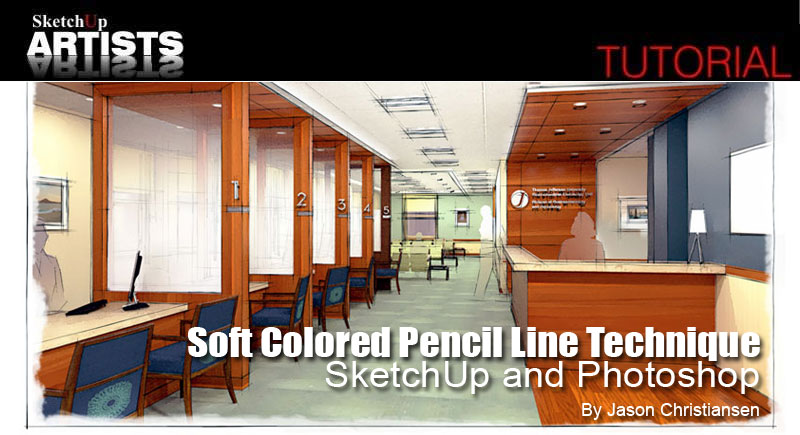
Tutorial: Soft Colored Pencil

Sketchupartists.org has released a new tutorial from Jason Christiansen. Read it more by clicking HERE.